
The UK's Native amphibians
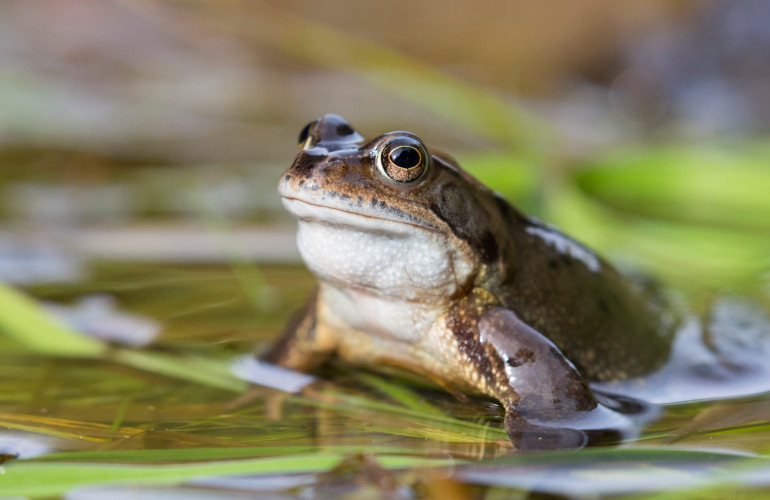
Seven species of amphibian – frogs, toads and newts - are native to the UK, many of which might just be found in your garden pond.
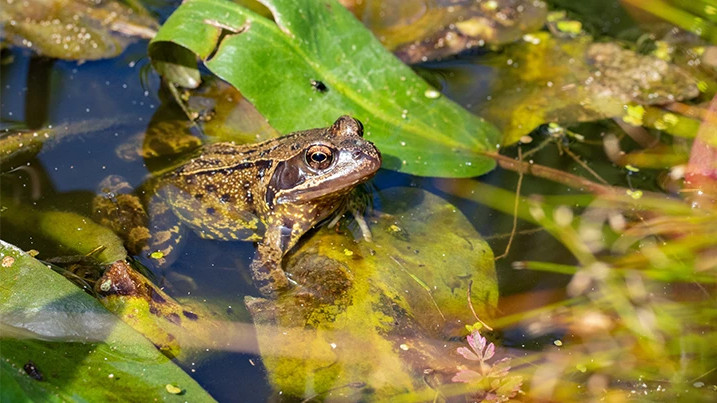
Common frog
Found throughout the UK, they can be identified by their smooth skin and long legs; perfect for hopping. Varying hugely in colour, they will usually have dark spots and stripes and a ‘mask’ behind the eye. Tadpoles are faintly speckled golden-brown, commonly found in garden ponds; an extremely important breeding habitat for this species. Common frogspawn is laid in large clumps at the surface.
Latin: Rana temporaria
Latin: Rana temporaria
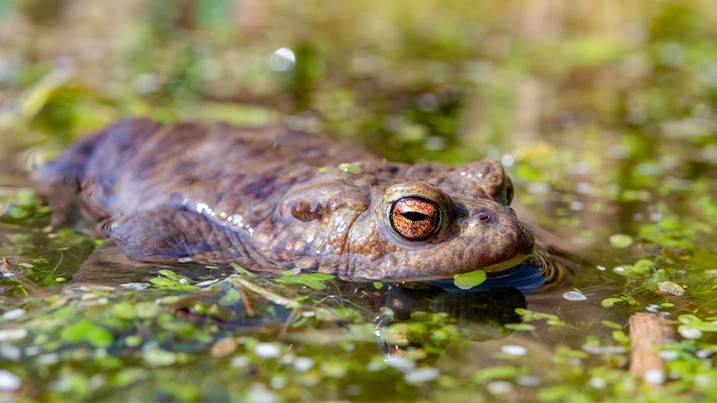
Common toad
Often a dark sandy colour, they can be told apart from the common frog by their flat, broad bodies and warty, dry skin. They also usually crawl rather than hop. Widespread across mainland UK, they’re famous for migrating en-masse in the early spring to their breeding ponds after emerging from their winter hibernation. Toadspawn is laid in long strings and toad tadpoles are solid black in colour.
Latin: Bufo bufo
Latin: Bufo bufo
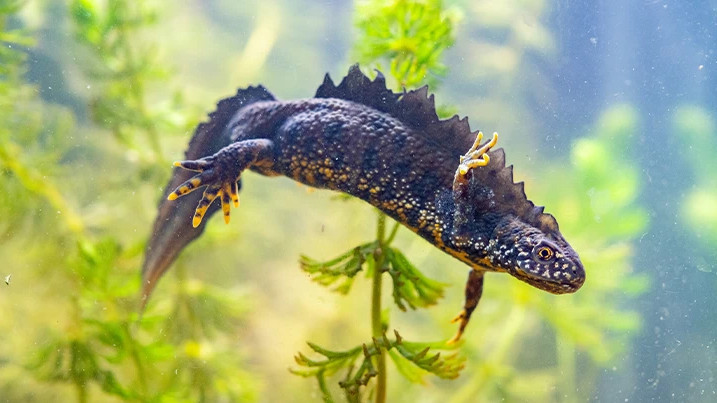
Great crested newt (GCN)
Our biggest newt – they can get to be 15cm long! Mostly black in colour with warty skin, white-spotted flanks and a striking orange belly (as unique as a human fingerprint). Males have a long, wavy crest along the body and tail during the breeding season. They’re patchily distributed across the UK as they suffer significantly from habitat loss. In spring, females lay around 300 eggs, one by one, inside the leaves of aquatic plants.
Latin: Triturus cristatus
Latin: Triturus cristatus
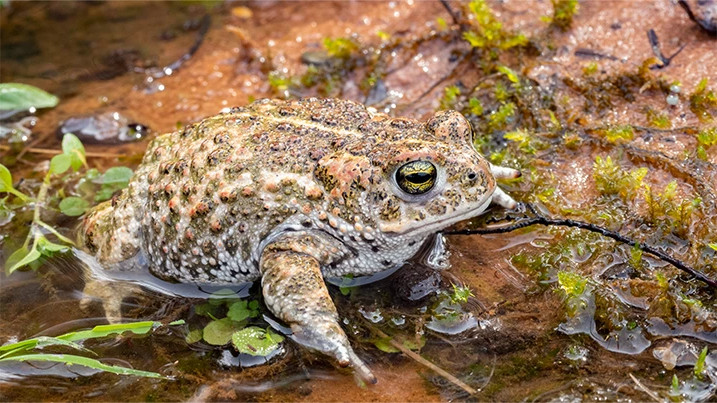
Natterjack toad
Smaller than the common toad with variable colouring, they breed in warm, shallow, ephemeral pools. Although they breed in ponds, they spend a lot of time on land; on quiet spring nights, their loud rasping croak can be heard up to 2km away as the males all sing together to attract females, who lay single strings of spawn unlike the double strings of common toad. They are sadly now rare and are largely restricted to coastal sand dunes.
Latin: Epidalea calamita
Latin: Epidalea calamita
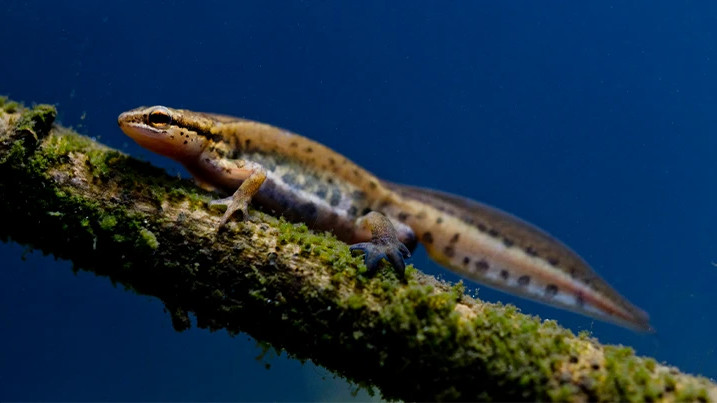
Palmate newt
This species looks very similar to the smooth newt, but is less likely to be found in garden ponds. Instead they prefer shallow pools on acidic soils, such as upland, heathland and moorland. They have a few spots on their belly but none on the throat, unlike the smooth newt. During the breeding seasons the males develop black webbing on their feet, for which they are named. Eggs, like those of the other newt species, are laid singly on plants.
Latin: Lissotriton helveticus
Latin: Lissotriton helveticus
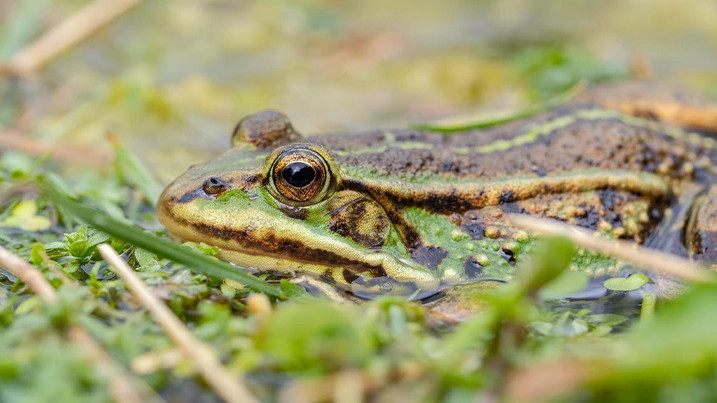
Pool frog
Brown or green with dark blotches and a lighter stripe along their back, with a pair of ridges that run from the eyes, down the back. Breeding later in the year than our other frogs and toads, their spawn is laid in small rafts coinciding with the onset of warm nights in May/June, when our other species’ young are likely to already be walking on four legs. Extinct from the UK by the mid-90s, they have since been reintroduced to a handful of sites in Norfolk.
Latin: Pelophylax lessonae
Latin: Pelophylax lessonae
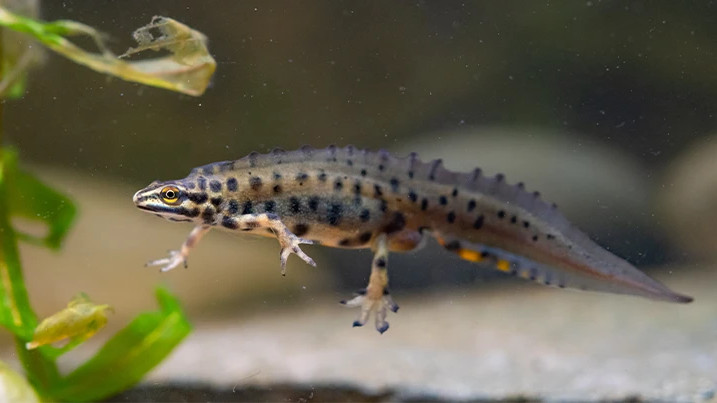
Smooth newt
Also known as ‘common’ newt, they are smaller than the great crested newt but with similar belly markings and wavy crest of the male in the breeding season. They’re widespread in the UK and the most likely newt species that you will find in a garden pond. Single eggs are laid, wrapped in a leaf. You can distinguish newt larvae from toad and frog tadpoles as they have obviously feathered gills.
Latin: Lissotriton vulgaris
Latin: Lissotriton vulgaris
Non-native amphibians in the UK
Along with the native species, there are several non-native species that have escaped from captivity or introduced into the wild.

African clawed toad
This unusual looking largish toad is almost exclusively aquatic. Its presence in this country is due to its use in pregnancy tests. There have been occasional escapes from laboratories on the Isle of Wight and in south Wales. Despite its origin in Africa it is extremely hardy although we have no record of it breeding here.
It is a very plump toad, usually a plain greyish or brown in colour and relatively smooth skinned. It's eyes are mounted almost directly on top of its head. It has very hard claws on its hind feet - thus the name. It feeds primarily under water, stirring up the silt and mud at the bottom of pools and streams searching for prey. Again it has a voracious appetite and must be regarded as a threat to many native species.
Latin: Xenopus laevis
It is a very plump toad, usually a plain greyish or brown in colour and relatively smooth skinned. It's eyes are mounted almost directly on top of its head. It has very hard claws on its hind feet - thus the name. It feeds primarily under water, stirring up the silt and mud at the bottom of pools and streams searching for prey. Again it has a voracious appetite and must be regarded as a threat to many native species.
Latin: Xenopus laevis
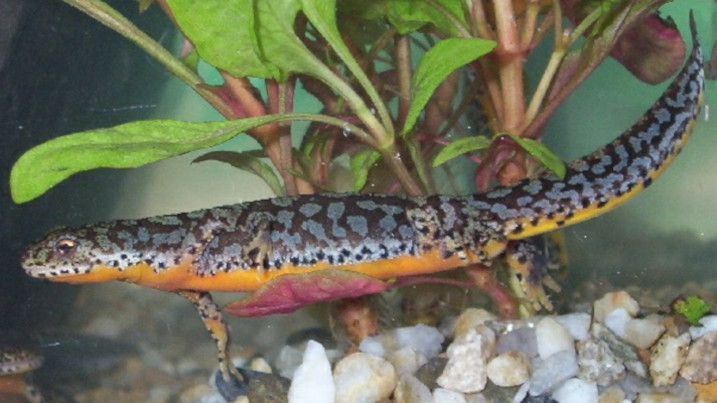
Alpine newt
Another frequent escapee from captivity which seems to thrive in this country. It is of much the same size as our two smaller species of newt and is thus not so easily noticed as the Italian crested newt. It can however be easily identified being very dark, frequently black in colour with a blueish tint. It has a bright red underside and some specimens have a suggestion of a red vertebral stripe. It does not appear to be common in the UK but certainly is widespread.
Latin: Mesotriton alpestris
Latin: Mesotriton alpestris
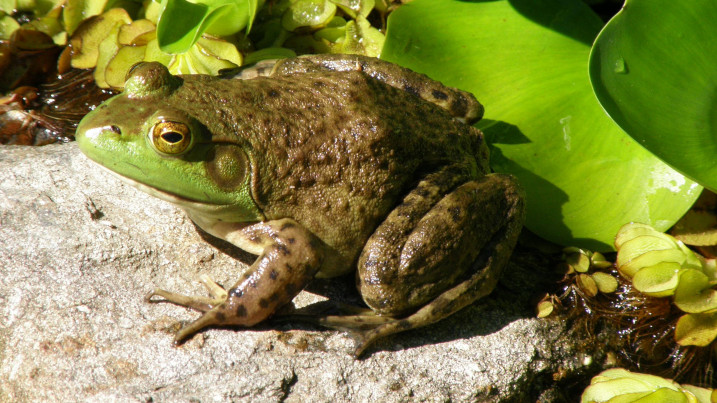
Bull frog
This large (up to 25 centimeters long) frog from the United States is the real menace amongst our introduced species. It has a voracious appetite and will eat just about anything smaller than itself. It thus presents a serious threat to much of our wildlife. Apart from its sheer size the call of the males is unmistakable - it is from this call that the frog gets its name. It is found in this country largely as a result of its tadpoles being sold in pet shops. More often than not the frog, once metamorphosed, is deliberately released by thoughtless people, or escapes. It's distribution in the UK is extremely sporadic but it has been known to breed in the wild which is of grave concern. Of all our introduced species this gives most cause for concern and complete eradication from the wild in this country is essential.
Latin: Lithobates catesbeianus
Latin: Lithobates catesbeianus
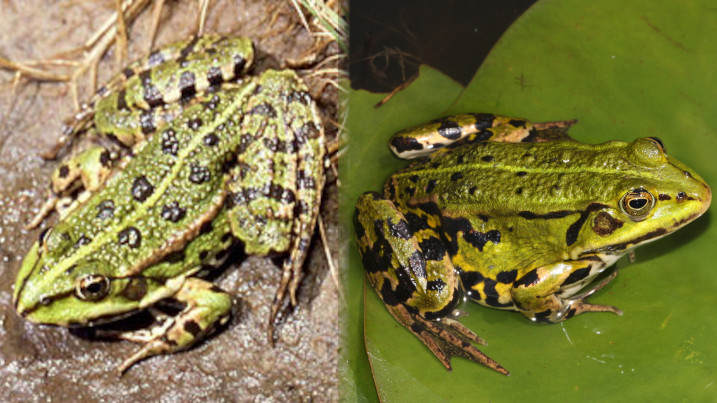
Green frogs
Marsh frog (Left) & Edible frog (right)
These two frogs form an unusual species complex (which includes our native pool frog due not only to their close relationship but also the results of them inter-breeding.
The marsh frog was introduced in the mid thirties on the edge of Romney Marsh. It has since expanded throughout most of the marsh and much of the surrounding countryside in both Kent and Sussex. Other introductions have occurred and it can be found at various locations, throughout southern England in particular. It is the largest and most distinctive of the green frogs.
The edible frog is harder to differentiate. It has been introduced, particularly in southern England. It has proved to be particularly successful in East Anglia and south-eastern England. The complex of waterways and ponds in Surrey and the north of Sussex have a clearly growing population.
Both species have quite loud calls during the breeding season. This is typically in May, much later than the common frog. The tadpoles grow considerably larger before metamorphosis and on occasion will over-winter and metamorphose early in the following spring.
The two species can be told apart by the length of the back leg and the size of the meta-tarsal tubercle - this is a bulge found at the base of the shortest rear toe. The marsh frog has the longest hind leg in proportion to its body with the smallest metatarsal tubercle. The edible frog has shorter hind legs and a larger metatarsal tubercle.
Latin: Marsh frog - Pelophylax ridibundus • Edible frog - Pelophylax esculentus
These two frogs form an unusual species complex (which includes our native pool frog due not only to their close relationship but also the results of them inter-breeding.
The marsh frog was introduced in the mid thirties on the edge of Romney Marsh. It has since expanded throughout most of the marsh and much of the surrounding countryside in both Kent and Sussex. Other introductions have occurred and it can be found at various locations, throughout southern England in particular. It is the largest and most distinctive of the green frogs.
The edible frog is harder to differentiate. It has been introduced, particularly in southern England. It has proved to be particularly successful in East Anglia and south-eastern England. The complex of waterways and ponds in Surrey and the north of Sussex have a clearly growing population.
Both species have quite loud calls during the breeding season. This is typically in May, much later than the common frog. The tadpoles grow considerably larger before metamorphosis and on occasion will over-winter and metamorphose early in the following spring.
The two species can be told apart by the length of the back leg and the size of the meta-tarsal tubercle - this is a bulge found at the base of the shortest rear toe. The marsh frog has the longest hind leg in proportion to its body with the smallest metatarsal tubercle. The edible frog has shorter hind legs and a larger metatarsal tubercle.
Latin: Marsh frog - Pelophylax ridibundus • Edible frog - Pelophylax esculentus
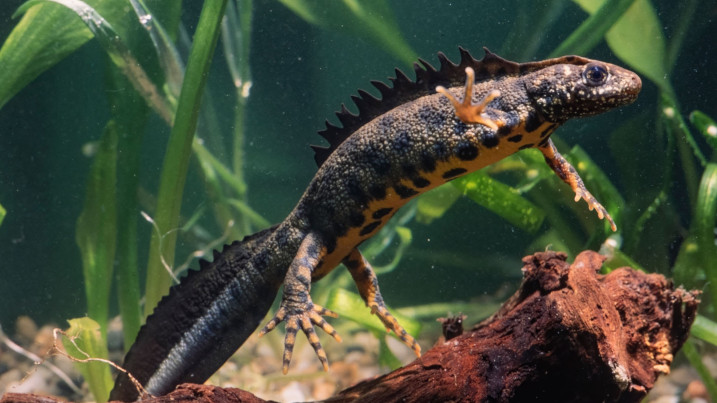
Italian crested newt
This newt is closely related to our own great crested newt (Triturus cristatus) and was, in fact, formerly regarded as a sub-species. This species has appeared in the UK largely as escapees from captive populations. While it is a beautiful animal it does, unfortunately represent a threat to our native species as it shares habitat and the two species readily inter-breed. It is widespread in the south of England but fortunately not common.In appearance it is very similar to the great crested newt, but distinguishing characteristics include very little (often none) white stippling on the flanks, a somewhat smoother skin and the presence of a yellow or reddish vertebral line in juveniles and females.
Latin: Triturus carnifex
Latin: Triturus carnifex
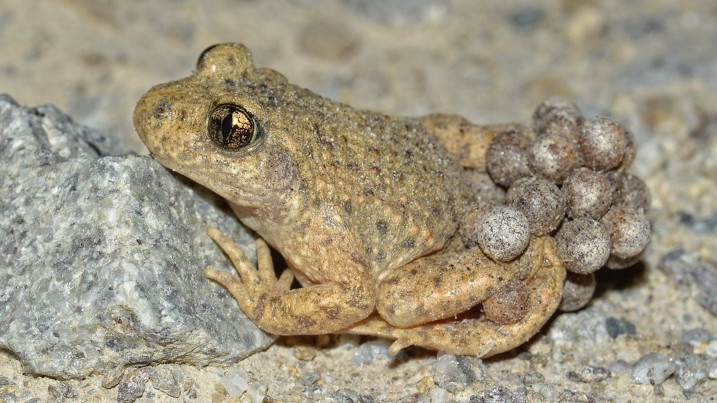
Midwife toad
A native of northern Europe, the midwife toad was introduced into a garden in Bedford at the end of the nineteenth century. It thrived and expanded in the locality and further colonies were started in Yorkshire, Worksop and south Devon. In addition, other colonies have arisen from escapees from captivity. The current status of most of these colonies is now unclear but it is safe to say that a number remain in the wild. Fortunately they do not appear to represent a significant competitive or predatorial threat to our native wildlife.
This is a small greyish toad, nocturnal in habit and preferring small ponds for breeding. The males have a call similar to a single bell-like tone - thus their other name; the Bell Toad. Their breeding habits are unusual. The spawn string contains a small number of eggs and immediately after fertilisation the male wraps it around his hind limbs and carries it around until the eggs are ready to hatch. It then visits a suitable pool where they hatch and swim away. The tadpoles grow exceptionally large, but the speed of growth is such that they often have to over-winter as tadpoles and metamorphose in the following spring.
Latin: Alytes obstetricans
This is a small greyish toad, nocturnal in habit and preferring small ponds for breeding. The males have a call similar to a single bell-like tone - thus their other name; the Bell Toad. Their breeding habits are unusual. The spawn string contains a small number of eggs and immediately after fertilisation the male wraps it around his hind limbs and carries it around until the eggs are ready to hatch. It then visits a suitable pool where they hatch and swim away. The tadpoles grow exceptionally large, but the speed of growth is such that they often have to over-winter as tadpoles and metamorphose in the following spring.
Latin: Alytes obstetricans
Wildlife legislation in the UK is complicated, both through its steady evolution and amendment creating numerous different acts, regulations and statutory orders, etc, but also because the Environment is a devolved function for the different country administrations in the UK. Therefore different legislation (and policy) has developed in the different countries of the UK. It is also further complicated by the interaction between national, European and international legislation and jurisprudence. Different levels of protection apply to different species.
Follow the links below to see summaries which identify the protection afforded to reptile and amphibian species in England and Wales, Scotland, Northern Ireland and the Isle of Man through nature conservation legislation; we have not addressed site/habitat protection mechanisms. Some additional protection can be afforded through animal welfare legislation and through other measures, such as land use planning regimes.
Follow the links below to see summaries which identify the protection afforded to reptile and amphibian species in England and Wales, Scotland, Northern Ireland and the Isle of Man through nature conservation legislation; we have not addressed site/habitat protection mechanisms. Some additional protection can be afforded through animal welfare legislation and through other measures, such as land use planning regimes.
The loss and degradation of wetland habitat has hit amphibians hard, with 40% of species declining worldwide according to a 2019 UN report, and the UK is no exception.
41% of amphibians are threatened with extinction worldwide, primarily due to:- Wetland habitat loss and degradation through pollution
- Invasive species
- The effects of climate change e.g. increased forest fires and droughts
- Diseases such as that caused by the chytrid fungus
- Human involvement i.e. road deaths and the pet trade
| Legislation | Countries |
|---|---|
| Wildlife & Countryside Act 1981 |


|
| Conservation (Natural Habitats & c.) Regulations 1994 |
|
| The Conservation (Nature Habitats, etc.) Regulations (Northern Ireland) 1995 More info... |
|
| Countryside & Rights of Way Act 2000 |
|
| Nature Conservation (Scotland) Act 2004 More info... |
|
| The Conservation (Natural Habitats etc) (Amendment) Regulations (Northern Ireland) 2004 More Info... |
|
| Natural Environment and Rural Communities Act 2006 |
|
| Conservation (Natural Habitats & c.) Amendment (Scotland) Regulations 2007 More info... |
|
| The Conservation (Natural Habitats, etc.) (Amendment) Regulations (Northern Ireland) 2007 More info... |
|
| The Environmental Damage (Prevention and Remediation) Regulations 2009 |
|
| Conservation of Habitats and Species Regulations 2010 |
|
Penalties on conviction – people committing amphibian related crimes can face six months imprisonment and/or unlimited fines. Additionally any profits made as a consequence of not following lawful process can be confiscated and items used to commit the offences such as vehicles, plant or machinery can be forfeited.
Licences to permit illegal activities relating to GCNs and their breeding sites can be issued for specific purposes and by specific licensing authorities in each country. These are sometimes called 'derogation licences' or 'European Protected Species' licences, and are issued under the Habitats Regulations. It is an offence not to comply with the terms and conditions of a derogation licence. If you carry out work affecting GCNs or their breeding sites without a licence, you will be breaking the law.
Related services
We specialise in bat conservation consulting and offer a variety of services that focus on the conservation of the UK amphibian population.
- Habitats Regulations Assessment (HRA)/Appropriate Assessment
- Great crested newt survey (torchlight, net, bottle-trap, egg search, larval, adult, terrestrial)
- GCN Habitat Suitability Index (HSI) assessments
- Natterjack and alien/non-native amphibian surveys